


Combining Stability, Workability, and Creative Storage Design
Making the most of limited living space starts with choosing the right materials. Birch plywood offers a practical balance between structural performance and natural beauty.
Contents :
1. Why Is Birch Plywood Becoming a Popular Choice for Storage Furniture?
2. How Does Wood Structure Affect Cabinet Stability?
3. Cross-Laminated Veneers: The Key to Birch Plywood Stability
4. Better Workability for More Flexible Furniture Design
5. Exposed Plywood Edges: Turning Material Structure into Design
6. Full Birch Plywood: Material Quality Beyond the Surface
7. TFSI | Your Professional Timber Solutions Partner
Why Is Birch Plywood Becoming a Popular Choice for Storage Furniture?
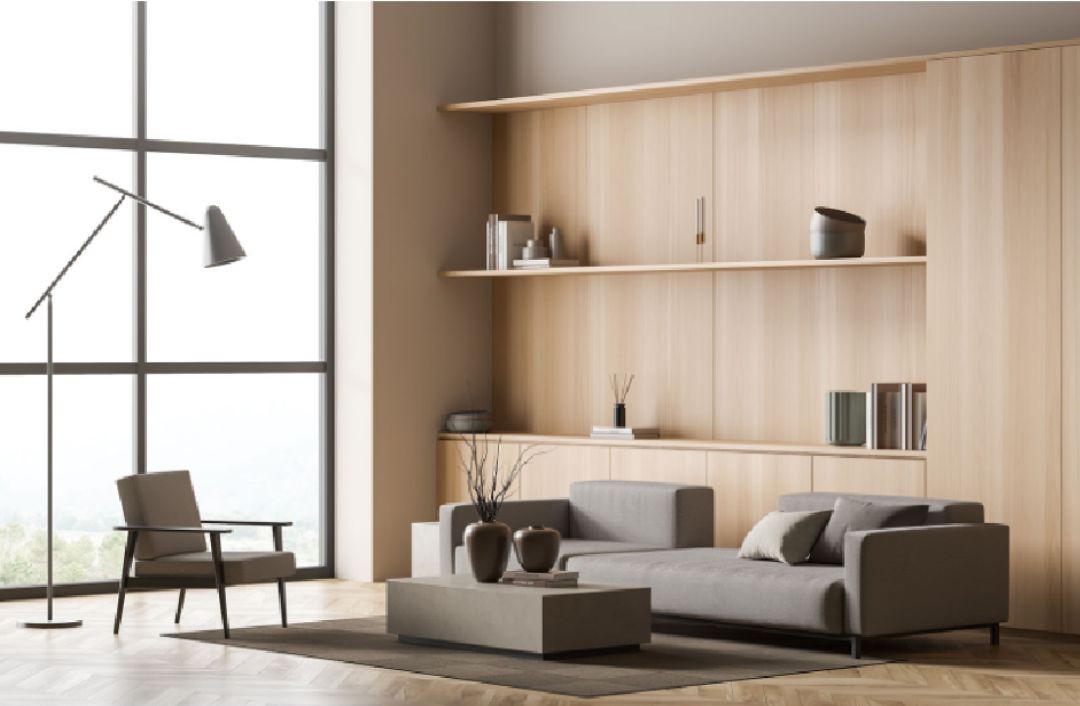
In modern homes with limited space, well-designed storage furniture can make a significant difference in everyday living.
Shoe cabinets, wardrobes, display units, and open shelving must provide sufficient storage while maintaining an attractive appearance and reliable long-term performance.
Solid wood was traditionally regarded as the preferred material for high-quality furniture. Plywood, however, was often considered a more affordable alternative.
Today, advances in wood processing and changing interior design requirements have encouraged more designers to select birch plywood for furniture and cabinet construction.
Its advantages go beyond its light color and attractive grain.
The layered construction of birch plywood provides dimensional stability, good workability, and greater flexibility in furniture design.
These qualities make it particularly valuable for modern storage solutions where both appearance and functionality are important.
How Does Wood Structure Affect Cabinet Stability?
One of the common challenges in cabinet construction is controlling material movement.
Wood naturally absorbs and releases moisture in response to changes in environmental humidity.
Since wood expands and contracts differently along and across the grain, uneven movement can cause cabinet doors and other wooden components to warp or crack.
Solid wood provides excellent strength along the grain, but its dimensions can change as moisture levels increase or decrease.
Plywood addresses this challenge through a different material structure.
By arranging wood veneers in alternating grain directions, plywood helps balance internal stresses and limit dimensional changes.
This makes plywood generally more resistant to warping and splitting caused by humidity changes than solid wood.
For furniture manufacturers and interior designers, understanding the internal structure of a panel is just as important as selecting its thickness and surface appearance.
Cross-Laminated Veneers: The Key to Birch Plywood Stability
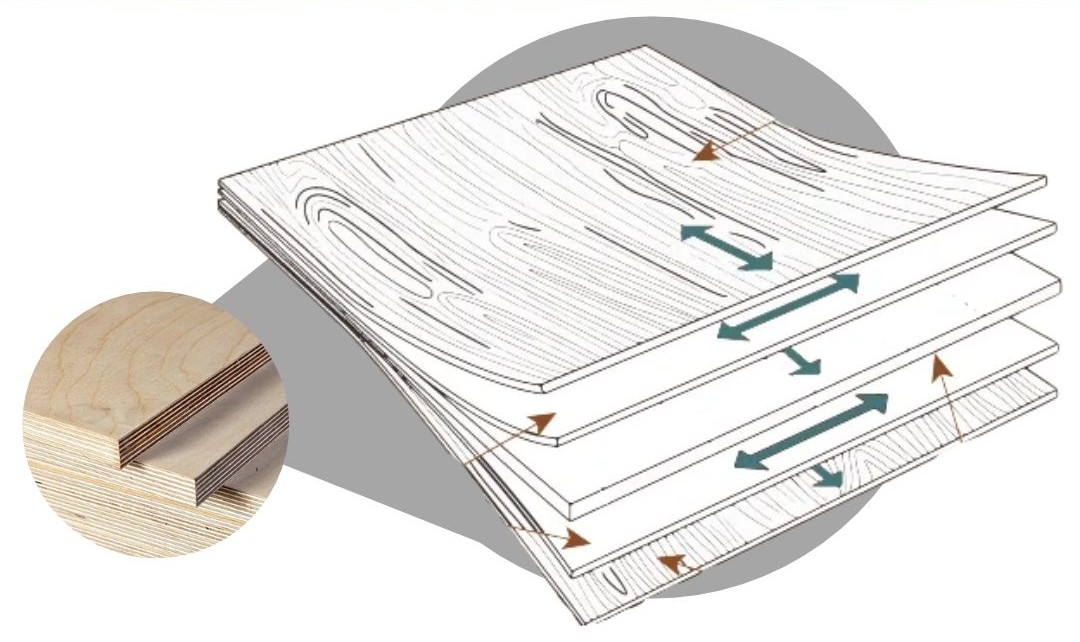
Birch plywood consists of multiple thin birch veneers bonded together under controlled manufacturing conditions.
Each veneer is positioned with its grain direction perpendicular to that of the adjacent layers.
The veneers are typically arranged symmetrically in an odd number of layers, creating a balanced panel structure.
As humidity changes, the alternating layers help control each other's natural expansion and contraction.
This construction reduces dimensional movement in both the length and width of the panel, helping it maintain its shape over time.
In regions with humid climates, this characteristic is particularly useful for furniture and cabinetry.
Large cabinet doors, wardrobe side panels, and complete storage units can benefit from the dimensional stability of birch plywood.
With suitable panel selection and installation, manufacturers can create furniture that combines visual quality with reliable long-term performance.
Better Workability for More Flexible Furniture Design
Material selection also influences how easily a furniture design can be manufactured.
The alternating grain structure of birch plywood provides good strength in both panel directions, reducing the risk of splitting along a single grain direction.
This makes birch plywood suitable for a wide range of woodworking processes, including:
- • Cutting narrow strips and custom shapes
- • Drilling holes for furniture components
- • Creating grooves and joints
- • Manufacturing large cabinet doors
- Producing customized storage units
Birch plywood is also available in large panel sizes.
Unlike wide solid wood surfaces, which may require several boards to be joined together, plywood can provide a continuous surface without additional board joining.
This gives furniture manufacturers more flexibility when producing large components, open shelving, and customized furniture.
For designers working with limited interior space, these processing advantages create more opportunities to develop practical and creative storage solutions.
Exposed Plywood Edges: Turning Material Structure into Design
Birch plywood offers more than structural and manufacturing advantages.
Its pale color and fine wood grain help create bright, natural, and comfortable interiors.
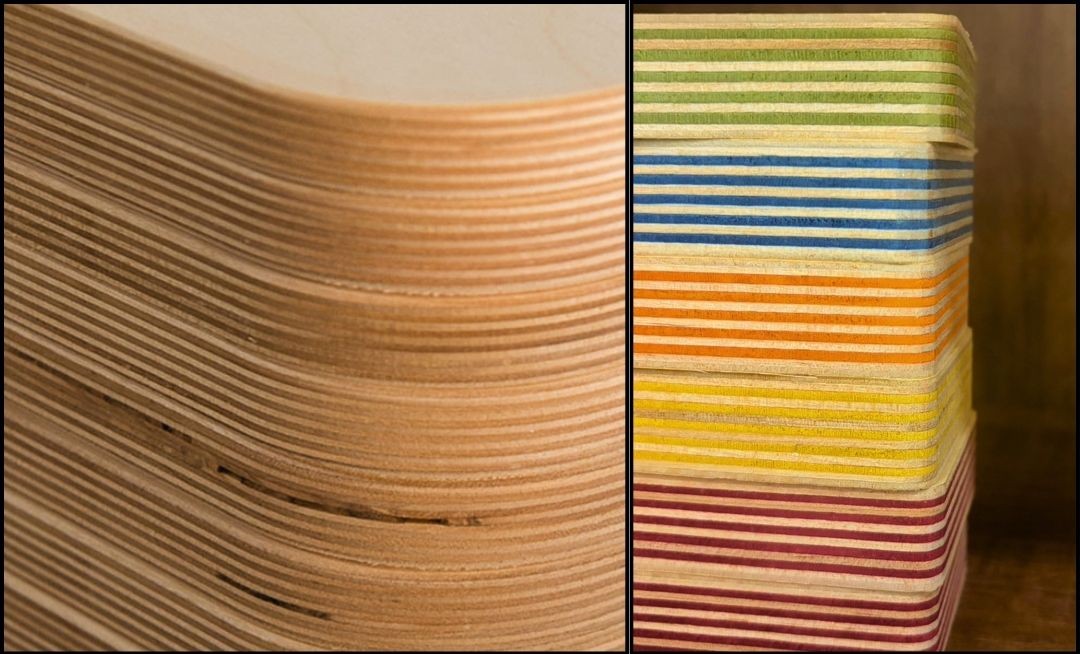
One of its most recognizable features is the layered pattern visible along its cut edges.
Traditionally, plywood edges were often hidden behind edge banding or decorative finishes.
In modern furniture design, however, these layers can be left visible with suitable surface finishing.
The alternating veneer lines create a distinctive visual detail, allowing the natural construction of the panel to become part of the finished product.
This design approach makes birch plywood suitable for more than conventional cabinetry.
It can also be used for pegboard storage systems, open display shelves, wall-mounted storage units, and even cat climbing furniture designed to fit into the layout of a home.
These applications demonstrate how a single material can support both practical storage needs and creative interior design.
Rather than covering the material's natural characteristics, designers can use them to create a distinctive appearance.
Full Birch Plywood: Material Quality Beyond the Surface
For furniture manufacturers and interior material suppliers, plywood quality involves more than the appearance of the face veneer.
Full Birch Plywood is manufactured using birch veneers throughout the panel, including both the outer surfaces and the inner core.
Its cross-layered construction provides a combination of dimensional stability, good processing performance, and natural wood texture.
These properties make it suitable for cabinetry, furniture manufacturing, and interior applications.
Formaldehyde emissions are another important consideration, especially in small homes where wooden cabinets may occupy a large portion of the interior space.
Selecting plywood with low formaldehyde emissions allows designers and manufacturers to consider indoor environmental quality alongside appearance and functionality.
Responsible timber sourcing is equally important.
Full birch plywood made with FSC-certified raw materials supports responsible forest management and helps customers address sustainability requirements in their material selection.
TFSI | Birch Plywood Solutions for Furniture and Cabinet Manufacturing
From compact residential storage systems to customized furniture production, birch plywood offers a practical combination of material stability, processing flexibility, and natural appearance.
Selecting suitable plywood requires careful consideration of panel dimensions, thickness, veneer quality, emission levels, and processing requirements.
TFSI provides international timber supply solutions for furniture manufacturers, cabinet producers, timber importers, and interior material suppliers.
Our full birch plywood products offer low formaldehyde emissions and FSC-certified material sourcing options, supporting different furniture manufacturing and interior design requirements.
We also assist customers with product specifications, relevant test documentation, customized dimensions, and processing requirements.
Contact TFSI to learn more about our birch plywood products and find suitable material solutions for your next project.
Read More

Related Product


Reference :
木材橫向與縱向的膨脹差異、單板交錯膠合互相牽制、合板長寬兩向穩定:https://research.fs.usda.gov/download/treesearch/5888.pdf
合板以奇數層對稱排列、維持結構平衡:https://www.designingbuildings.co.uk/w/Plywood